Monday, 26 October 2015

Journal Study: A Wolf in Tiger's Clothing

A Wolf in Tiger's Clothing: Danger, Desire, and Pleasure in Judith Kerr's The Tiger Who Came to Tea. Written by Tim Beasley-Murray, published by Children's Literature Association and found through Academia. This paper discusses whether the Tiger within the Story is not really a tiger at all. One of the reasons I had decided to read this paper was that I had been to look at the original art created for this particular book when I was down in Gateshead at the Seven Stories archive. There are several areas of interest within this paper with reference to Kerr's own life in relation to being  the daughter of a Jewish opponent to the Nazi regime. The knock at the door possibly being a threat most Jews were afraid of, hence the reason her family moved to the UK. However there are elements touched upon which I don't agree with such as the careworn and all too human Father not being cast as a virile huntsman, one who is only disappointed when there is no supper. This is a theme that showed also in some of Kerr's unpublished works I also looked at, mainly The crocodile under the bed. Again I was able to look through the original art for this book which contained several scenes where the father missed out on supper for various reasons. Perhaps it was as simple as that the rest of the family were to eat during these times of war often leading to the father missing out? Maybe they were all starving on the rations they were given but with her father it was more noticeable? One area of this paper I am unsure about is the references to the sexual nature of the book. I understand the tiger is unlikely to just be a tiger, it most likely represents some dominant person or intruder into their lives such as the Gestapo.
I have come to realise that at present I feel my research seems a bit sporadic, which is maybe just how I work. My thoughts are to continue in this way without worrying too much, my aim is to try to find any papers that interest me or are related to my area of study. Once I have marked up which parts of these papers deal with issues of interest and I have went through enough I will begin to collate. The information from each will be extracted, placed together and then assembled with all others in the same fashion. Hopefully this will allow me to recognise patterns, highlight issues that resonate with me and should then help me push all of this seemingly random information together in order to direct one coherent area of research. Again this will require many more readings and may also only highlight areas lacking in information but this is how I will approach this matter for now. Some extracts of the aforementioned paper are shown below.


Sunday, 25 October 2015

wc 25/10/15 progress, reflection and ideas

Progress

Programme of works continues to show reading journals, books for reference etc. Due to my limited knowledge of what my project actually was at the time of producing this programme this continues to be the topic of work. However I had not taken into consideration for any time working on project, building ideas, preparatory sketches etc. This is something to learn for future projects when creating such a programme of works. Over the last few weeks I have been researching in a more physical manner. My trips to the archive in Gateshead and many exhibitions in London have been a slightly different form of research rather than just purely books and journals. This week is a continuation of finding useful resources that can become valuable references. Also I was supposed to attend a workshop at DCA yesterday on Argyrotype printing. However this was cancelled due to lack of numbers attending, I still have another workshop to attend next weekend at DCA on pad printing. This will hopefully show me another method that could be useful for creating interesting textures.

Reflection

I feel that the time spent since my last progress check two weeks ago has probably been my most creative so far in this project. This is most likely due to the drawings I have done, the places I have been and the fact that I had purposely chosen not to take any journals etc to London just to give myself a bit breathing space. This also means that I now feel fresh after having had a short break. I know I must now get back into reading but I look forward to detailing the information I had already found but never blogged about, and now also have a fresh enthusiasm about reading the journals and books I found or purchased before my trips away.

Ideas

I need to have found several new relevant references about my subject by this time next week. This is crucial in letting me begin to build some idea of a proposal. Lately I have seen several exhibitions and a theatre production which will have most likely been reported on by numerous newspapers, magazines or hopefully more academic/professional sources. After finding more useful resources for this project I should consider trying to find some of these articles on the things I have seen lately. These may let me see how others have perceived the works and would let me compare my own thoughts and reactions, possibly leading to a better overall understanding of some of the works.

The art of visual storytelling


I bought this book several months ago whilst carrying out my creative research project. The book written by Martin Salisbury and Morag Styles will most likely become a reference book that I will look to many times in the future. The reason being that all manner of topics are covered and each time I am researching a variety of areas within picture books I will find some kind of useful information or be lead to another useful resource from this book.
There are several areas or topics that I have highlighted within the book that may become useful to my research towards this particular project. The chapter suitable for children talks on issues such as man's inhumanity to man, violence and death. All topics which are regarded as slightly taboo, however these are real life topics. These generate more interest in me and are things that I feel should be discussed with children and also highlighted to adults as issues to be raised. These types of issues also give me something far more gritty to work with and therefore create more of a challenge to me as an artist. The stories and images would require far more thought into how such subjects may be approached. What questions do I want to be asked, what discussions do I want to open up, and probably more importantly what is it about these types of subjects that interest me? Through this project and my research I hope to find answers to some of these questions.
Other areas show more of the workings or sketchbooks of picture book artists. Topics of traditions, perceptions of what picture books are, responses to picture books are all discussed within this book. This book also signifies to me the progress I am making as I actually met Martin when I was down in Cambridge a few weeks ago. Some of the highlighted areas of interest are shown below although I will go into more detail when required such as in my research proposal.


Saturday, 24 October 2015

Urban sketching


During my visit to London I bought a book from the shop in the RA. This little book caught my attention as the topic of drawing from real life has been on my mind lately. I have realised that I have fallen into the pitfall of only drawing for the projects I am working on rather than just drawing because something might interest me or to keep up my practise. This seems to have occurred with the types of projects that I have been doing over the last year or so. Learning how to write for children, projection mapping, the technical aspects of animation have lead me to slightly forget about these fundamental elements of art. Mainly the world we live in and the people, animals and plants the inhabit this world. They are the roots of all stories, all images, all art for that matter.
This has become more apparent to me as I have been looking into the works of many fantastic artists. One thing has struck a chord with me, how prolific many of the greatest artists actually are. How many proprietary drawings they create, how many seemingly unrelated sketches are drawn. These are the backbone of these artists successes, they lay the foundations for all of their art.
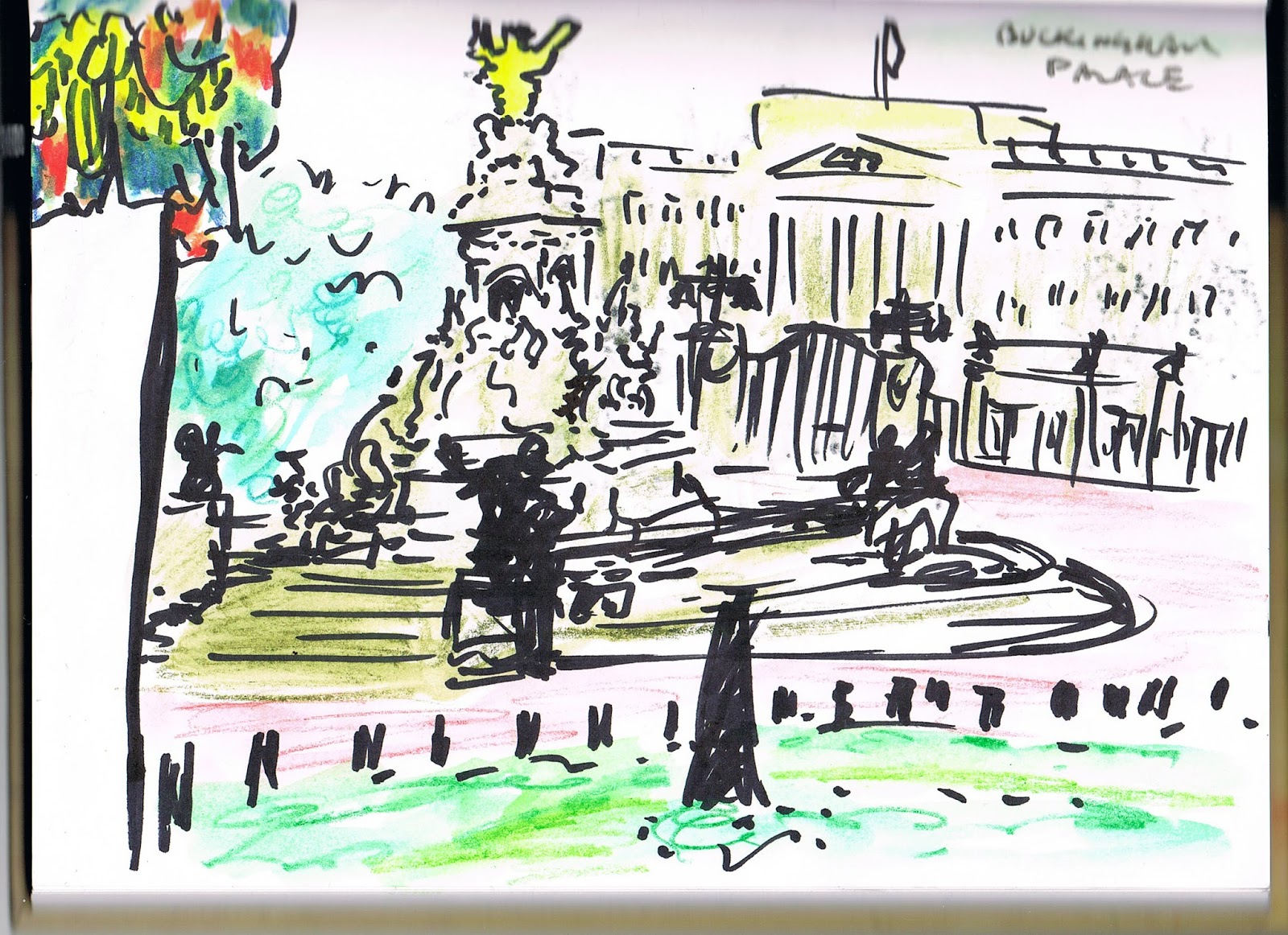
The book covers the topics of proportion, contour, gesture, expression, context, likeness and different mediums that can be used. The book is not groundbreaking new knowledge, instead it reinstates many things I have already been made aware of through my studies. However it does highlight that there are many things that I am not doing and if I want to be the best artist I can be then this has to change. This had already occurred to me prior to going to London but this little book just reaffirmed what I had been thinking and seems to have given me a jolt that was required. Sketching those in front of me became a huge part of my trip with a few of these shown below. The book did contain something very interesting at the very back, a set of challenges as shown above. I know that if I take on these challenges through the course of this project and then continue to keep up these challenges they will become a habit. One very good habit for any artist to have, the plan is to do these challenges but to continue building upon them. For instance drawing people on public transport does not mean that after drawing people on a bus I should simply tick it off as done. Instead I should think what other forms of public transport are there, sports events are the same as there is a variety of sports events I could attend. With each little sketch of each challenge my skills and knowledge as an artist will improve and eventually I will have built a catalogue of people and places they can then feed into the work that I produce.


The sketches of the people below were done after I had attended the E.H Shepard exhibition. Whilst drawing these people I noticed two main things, firstly I was paying far more attention to the person, the light and shadows, their features. Secondly I was also far more aware of the marks I was making, I was giving more consideration to which directions line should go, what could I leave out. The term economical use of line was going through my mind when sketching these people. I also realise that it would be very good practise for me to try other methods and use a variety of materials. One thought is to include backgrounds already covered in inks, colours, splashes, use coloured papers to create a mid tone that would allow me to only put marks down for the lightest and darkest areas. This idea probably comes from my knowledge that I need to work on tonal qualities. These sketches will also help build up my knowledge of composition as putting myself in many situations will lead to a better understanding of creating interesting compositions that can lead the eye through a drawing as I intend the viewer to see. Although the one major difference was that these people were rather still compared to others I had been doing previous to that point who were mostly walking past me at the time of drawing them.


Friday, 23 October 2015

E.H Shepard

The final exhibition I went to see whilst in London was that of illustrator E.H Shepard which was held in House of Illustration. Most prominently known for his illustrations of Winnie the Pooh and numerous cartoons for Punch magazine. However this exhibition focused on his works as a war artist during the first world war. Not solely sent out as an artist Shepard was a soldier who had wanted to serve and just happened to draw and paint whenever possible. The army was aware of his talents and would sometimes ask for him to produce landscapes to help them in making plans for attacks etc. He had already been working for Punch magazine prior to the break out of war, and continued producing work for them during the course of the war when possible. There is correspondence from his agent shown in the exhibition to his wife asking if she had heard from him as a deadline was looming.
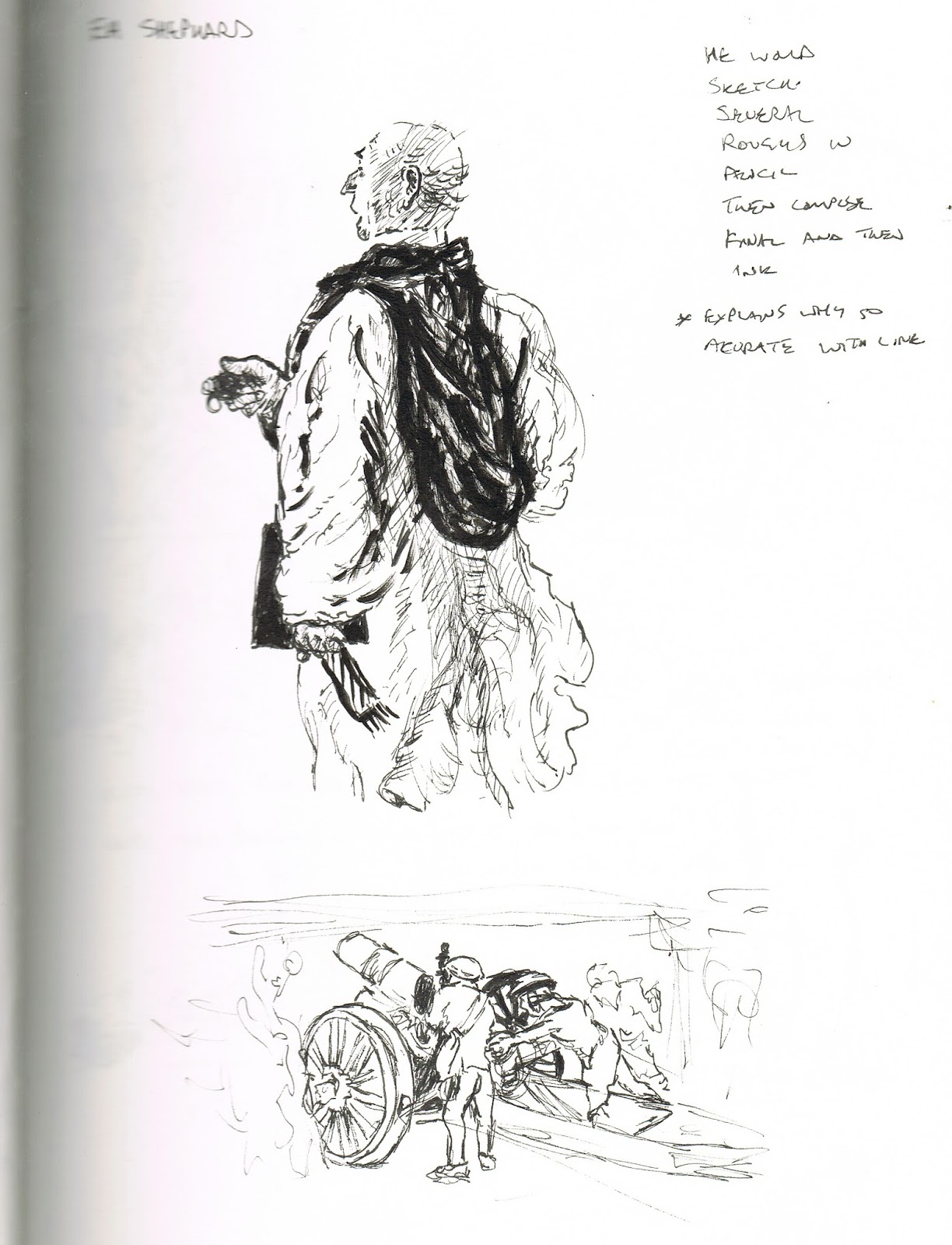
The war seemed to have help develop Shepard as an artist, he truly had to sketch quickly and become even more observant which can be seen through his art. Sketching several rough in pencil would finally lead to a finished image done in ink. Again the term economical use of line was used in describing his work. I understood this even more now as I use ink pens to sketch but I find that I probably try to draw too much. My overuse of line can sometimes kill the drawing, this is probably the most important factor that I picked up from this exhibition. I noticed that when sketching people later that day it was very evident that something had triggered me to think differently, to consider the line I was putting down. Also I realised that the best artists are usually the most observant, looking for shadows, glimmers of light, what makes that person them, what their features are. During my time in the exhibition I tried to imitate some of the images I seen mainly as an exercise in trying to reduce my line work and produce more effective illustrations. These drawings interested me in either composition or the characters within them, these are shown below.


The National Gallery

After visiting the Tate Modern I decided to leave and go and visit the National Gallery. Inside are many famous paintings by some of the most well known artists throughout the world. I went to see the famous sunflowers of Van Gogh only to find that I became more interested in his painting of two crabs and a portrait of a peasant woman. The two crabs were more interesting to me as I had never seen them before unlike Sunflowers which have been depicted man times through my life without actually seeing the works in it's original form. The crabs were interesting to me as they were such a peculiar subject to paint on their own. No seaside, no rocks no real context apart from a study of the crabs themselves. One belly up the other in a more usual position allowed the viewer to see a crab as a whole within an image. The other piece which was a portrait struck me as it was not in the style Van Gogh is usually associated with, the style conformed more to what others may have painted in his time. This was unusual for me and found this rather unexpected, perhaps this was before he developed his heavier stroked approach that we have become accustomed to seeing.
Another painting that struck a chord with me was titled Whistlejacket. The painting is of a horse and was created by George Stubbs. The painting seemed to dominate the room even though other works were larger, the room itself was huge. This was due to the striking nature of the painting which can be seen below. I drew a quick sketch of this horse just to remind me to look it up later, all images discussed are shown below.


Tate Modern

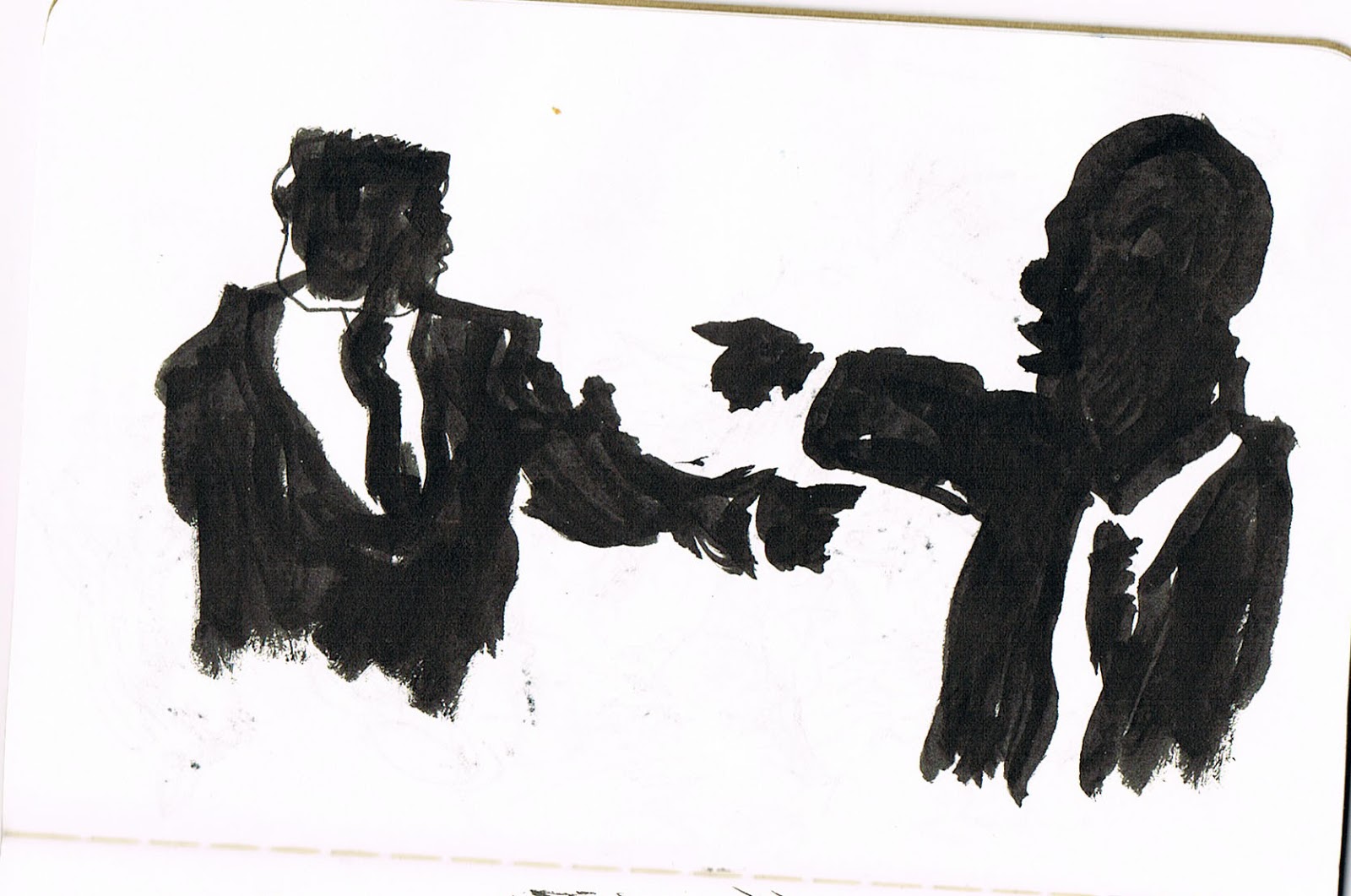
On tuesday I visited the Tate Modern to attend the EY exhibition The World Goes Pop. I went to this particular exhibition with an open mind as this was an attempt to step out of my comfort zone and to see artists works that I had never been aware of before. The aim was to try and understand the works that were on display, some of which I couldn't even after reading the descriptor. However many left me feeling rather disappointed after reading the descriptors. Most dealt with serious issues but seemed rather obvious, lacked thought or were just too abstract to understand, for me anyway. Even the image above is something I found interesting and was what actually enticed me to go in the first place. However seeing this image in person was not as effective or dramatic, the artist used many materials including cut out plastics to create this piece. After a while I found it difficult to get enthusiastic about this exhibition. After seeing such works as Ai WeiWei and the Waterloo Cartoon the art on display felt rather cheap and tacky in comparison. There were two pieces which I did find interesting, the first played on the cold war and showed silhouettes of both leaders on separate canvasses. The other which I did really like for it's dramatic impact was a piece by Rafael Canogar. This work showed the plight of brutality by authority, the person being beaten was sculpted lying on the ground. This sculpture was missing the head and and hand which were displayed on an upright board. The board showed a silhouette of the missing head and hand, also shown was the shadowy figure of brutality administering a beating to the person lying on the ground. By removing the head from the sculpture and the authoritarian figure only being in patchy silhouette the piece then opened up to interpretation. This would allow each person to see this as any person, place, country, regime or time that came to their mind. This was very clever as the characters being faceless allows the viewer to project any face the wish onto the piece. These works were sketched and shown below along with a sketch of the Tate Modern with school children drawing outside.