Sunday, 1 November 2015

Taku-Hon

Over the last two days I have attended a workshop on Taku-hon printing. This is an ancient Chinese technique although the name derives from Japan. I went to try to see if I could create textures similar to those found in a book titled The Ship that Sailed to Mars by William M Timlin (Fig 1).
Fig 1
To my surprise the technique allows for far more experimental and varied use than I had imagined. One really useful technique involved taking three dimensional objects and then printing from them. We wrapped the wet paper around whatever we decided, my example is that of a small drill (Fig 2). Once the paper had been worked into the grooves or details of the item we would then let it dry out until we felt ready to print. The item could then be inked using pads and the finished print might give  the object a brand new life. The print might not seem recognisable to the item itself but this was what seemed the most interesting to me. My example of a drill is shown below with a few other examples and the description sheet which gives more details about the technique itself. Prior to the weekend I had thought that my presentation would be unlikely to include this workshop, but this has not only shown me a new method of working it has shown me a new way to represent things in a totally different way and so will now be included.
Fig 2


Friday, 30 October 2015

Journal study: The elephant in the room

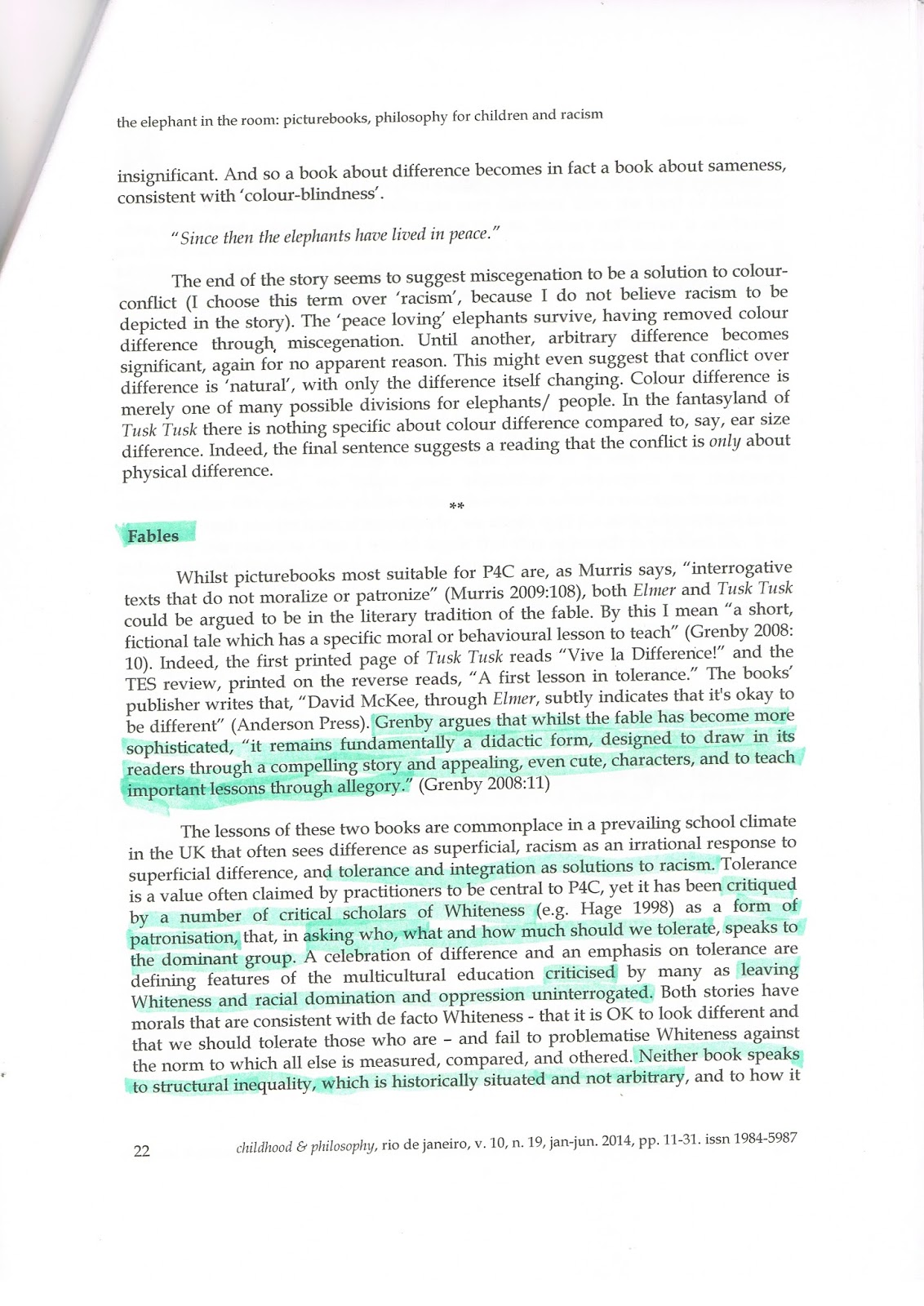
The elephant in the room: Picture books, philosophy for children and racism. This paper was written by Darren Chetty from the Institute of Education, University of London. The paper touches on topics of racism, whiteness, multiculturalism and diversity through the medium of picture books. An interesting read as the paper divulges into a very taboo subject when discussing picture books. There are many aspects within this paper that are of interest, however the most striking elements are regarding the topic of whiteness. An issue where most white people do not actually have to give a great deal of thought to race. The fact that a white person trying to talk or share about racism can often be perceived as difficult as they often do not truly understand many of they challenges other races have endured during times of slavery, colonisation, segregation and inequality.
This is perhaps why I might find the story of the Scots taken to Barbados so interesting. My own preconceptions about slavery have been turned on there head. If asked about slavery several months ago I imagine my first vision would have been boats full of native Africans leaving for many places over the world. However the historic story of Scottish slaves is easier for me to relate to therefore making it something I feel I can use a portrait through a picture book. Even though my actual motive is to question modern day slavery as many people believe such atrocities to be a thing of the past only written about in history books. Whether colonial slavery such as the British Empire, the Romans or Egyptians, slavery has always been. Today this issue may be more hidden but the issue still exists and is a daily struggle many people around the world must deal with. This paper has highlighted the issue of race but also how and why I might be able to relate to and want to use the story in my picture book. Some extracts from this paper are shown below.


My Presentation

Although my presentation on where I am currently situated with my project is not until Wednesday I felt it important to create the presentation over the last few days. Probably since after watching my peers present I realised how some people seemed to really understand their project, others seemed less clear and in some cases the audience might have understood the project more than the speaker.
As I stated in a previous blog that as I watched others present I felt quite comfortable with my own project, I feel it is now taking some form of direction. Creating the presentation now was helpful in seeing if these thoughts were correct as I prepared slides on which I will discuss.
With my first slide I intend to discuss where I am with the lead question that will drive the project. Although I have stated my current question I have also tried to show how I feel about my question through the image portrait. Funnily enough I realise I have tried to show my thoughts on a question about visual metaphors through a visual metaphor. I do feel often that I am at a crossroads with my question, however I do think that this will resolve itself once I begin to collate the information I have been looking through. This will allow me to evaluate what I have picked out and maybe give me a better understanding of the questions I am asking asking by the information that seems important to me, this will happen most likely after my presentation next week.
The next slide is to give indication as to why I wish to portrait my work through the picture book format. I will explain my interest in the medium and also the topics I find most interesting. Usually these are rather taboo topics such as war, migration, death, environmental issues etc. Themes which seem rather more adult orientated even though many are marketed as children's books.
I wish to then discuss my proposed concept. This is to use a story from hundreds of years ago when a battle to place in Dunbar. The Scots who were captured were sent to Barbados to work in the sugar cane fields as slaves. There are still direct decedents of these people living there today, they have been given the nickname red legs passed down from their forefathers. This was due to their light skin burning in the Caribbean heat of Barbados. The story is not intended to be historical or educational but will serve as the common thread through my story. This will hopefully allow me to raise the issue of modern slavery to give the story more of a sense of meaning and purpose.
My approaches to the project will then be discussed. My work so far has been mostly theoretical, however rather than working through my concept I have instead exposed myself to the work of others through exhibitions etc. I realise that what I have been trying to do is feed myself, with both information and inspiration that will hopefully show through my work once I begin a more practised based type of research.
I will then cover the aims and objectives of my project as shown above.
Discussing a lecture we had on creativity, a paper I read on embodied metaphors and creative acts and how they have affected my project. Explaining the concept of the experiments carried out as part of the issues studied in the paper and how they lead me to look at other sources of inspiration out with the field of picture books or illustration.
Detail how and why I thought it would be useful to watch the wordless play Dragon. Discuss my thoughts on breaking down the play into small thumbnails to see if I could transform the play into a picture book.
Opening myself up to highly conceptual works which are effectively visual metaphors. Discuss the works of Ai WeiWei in particular the two pieces bed and fragments. Which although entirely different pieces of work are actually the same thing, maps of china.
Discuss why I felt it important to attend workshops such as the one with Dominic MacKenzie. Run through the types of exercises we done trying to create visual metaphors for words as images, portrait metaphors, using articles and trying to compress them into one single image.
My aim in seeing the waterloo cartoon was to gain an insight into techniques. The fundamentals of tone, line to admire the draughtsmanship within the piece. The surprise that the most impressive aspect being the composition, the thought, the preparation and preliminary works that must have even preceded the cartoon itself.
Considering my own practices, talking about the works of E.H Shepard from the first world war. My realisation about my lack of good habits once I had read through my little urban sketching book. This has lead to me trying to draw much more from real life and establish a habit within myself that will serve me well as an artist.
My conclusion and discuss any issues with peers and tutors, take notes on any feedback.

New Directions in picture book research

This paper reflects upon the book as titled above, although I have found only a few extracts within the paper that are of interest to me. However the paper does highlight some names of people within the field in picture book research. Maria Nikolajeva seems to be mentioned through various practitioners and is someone whom I have asked to view papers from through academia. More local researchers such as Evelyn Arizpe whom I had not been aware of, Sandra Beckett is mentioned for her contribution through her book crossover picture books. This is a book that I have just had delivered last week so will hopefully have useful information to pull from such a resource. Although this particular paper has little for me personally it does show my progress within the subject area and my awareness of either people or literature within the research field. Some extracts which are highlighted are shown below.


Wednesday, 28 October 2015

Presentations

Today I have sat and watched many presentations on what my peers are looking at researching through their honours years projects. There was a great variety in the issues and topics discussed with  a real depth of approaches as uses of different mediums offered to deal with their research. The thing that probably struck me most was how many people seem to carry out practise based research. My own research seems to have been lead primarily through a more theoretical approach. This is perhaps due to my lack of a full understanding of my subjects of metaphors, semiotics, fables etc. This may seem rather strange saying that I don't fully understand my subject but in there lies the challenge for me. I know that before I pursue a more practical approach I first wish to understand my subject matter as fully as I can. My approach seems to be gathering as much information as possible from books and journals whilst at the same time gathering as many influences as possible through visiting exhibitions, plays, workshops etc.
I also realised that although still trying to grasp many of the concepts I am looking at I still feel very comfortable with my project. I understand what I want out of it in terms of my aims, and I have no concerns in how I am approaching the project. Most likely my research will remain theoretical with practical exercises thrown in (usually something new I have never tried before). Once I have handed in my research proposal my project will very quickly become practise based. This will occur as I will try to get to grips with my story and how it may work as a picture book through trials, storyboards, thumbnails and dummy books. I will also further my knowledge by carrying out case studies on a few books that interest me, this will be done by interview/questionnaires. The methods used for my case studies will hopefully inform how I may research people's reaction to my own work and gain an understanding of their interpretations.
Today was useful in many ways, firstly I got to see where many of my peers are heading with their work, secondly how they were approaching their subject and the kind of things they were doing, and finally it gave me chance to reflect upon my own project and where I find myself right now. I understand my methods of collecting information and inspirations, I am essentially feeding myself until I am full of info and ideas to utilise through my project. I have a good idea of where my project seems to be leading, my main question is currently based around how can visual metaphors be used to open up interpretations of picture books? The theme I am going to use is slavery, based around a story of slaves from Scotland which will be used as the thread that enables me to create a work of fiction from. The aim is to create a dummy picture book that could be shown to publishers, one that may also show much of the workings within drawings. My inspirations are not only taken from picture books but also from theatre, exhibitions of artists such as Ai WeiWei, Daniel Maclise and E.H Shepard, and my participation in various workshops.

Tuesday, 27 October 2015

Journal study: Creating Effective Visual Metaphors

The paper examines the use of visual metaphors with specific reference to human interaction with computers. this is understandable is the increased usage of mobile devices in particular rely on images to signify words. Gaining a better understanding of how visual metaphors may be considered, designed and used within other mediums may advance my own practise in treating such topics.
Visual metaphors can become easily recognised and even become part of an unspoken language when used correctly. However the metaphor firstly must be understood which requires learning.
The paper looks at how we use and create visual metaphors, what the requirements are and also how we can combine the visual with verbal. The areas of interest within this paper are highlighted and shown below, again this may become a point of reference in future.


Monday, 26 October 2015

Journal Study: Ling & Literature

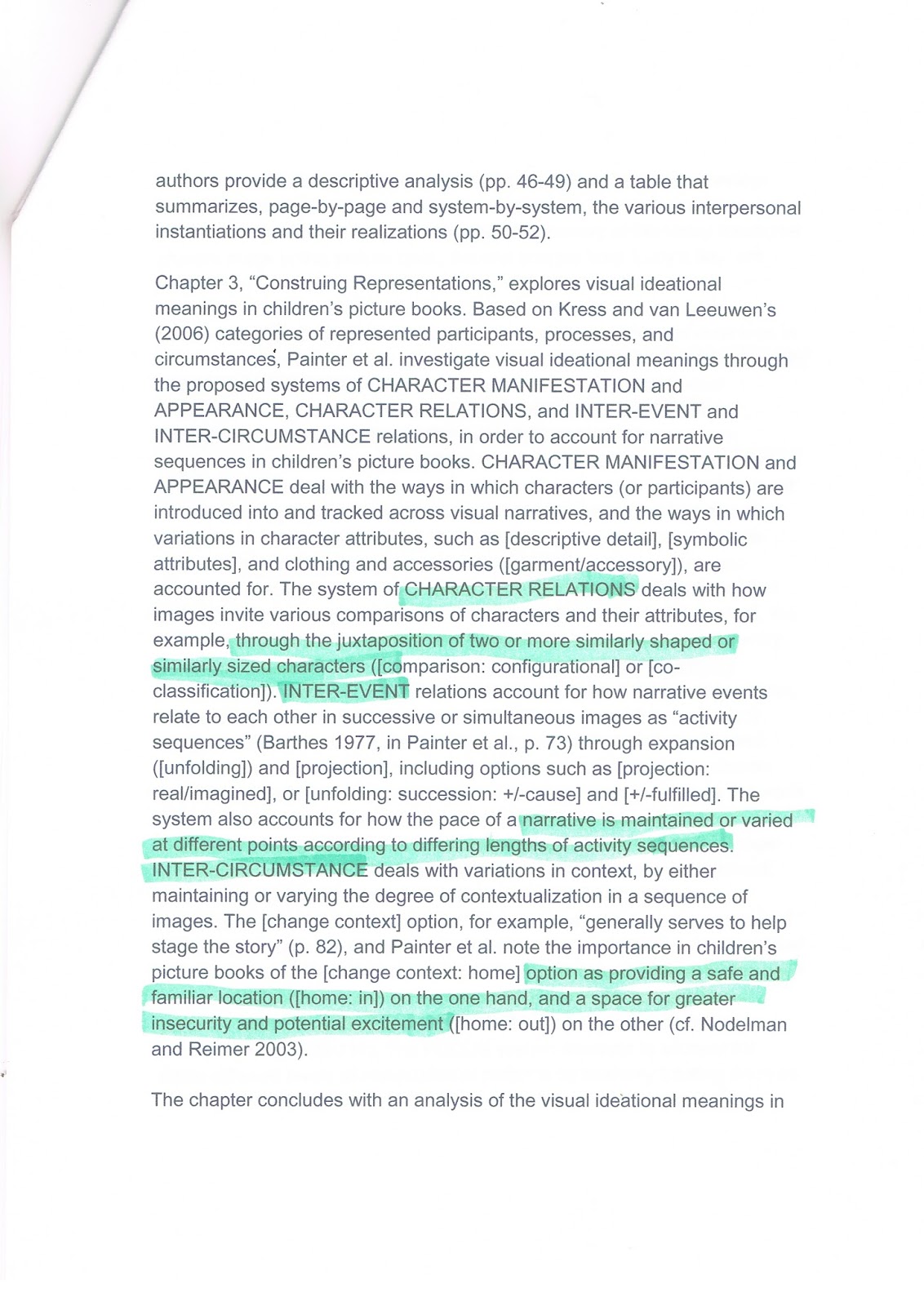
This paper is a review and analysis of a book titled Reading Visual Narratives: Image Analysis of Children's Picture Books. Although this paper rather dry it has exposed me too many terms I have been unaware of previous to this point. The world of semiotics is unknown to me, this give me something new and interesting to try and understand to see if it has relevance to me. Each chapter deals with various issues of Reading the Visual, Enacting Social Relations or Construing Representations and so on. This book seems to look beyond the mere visuals or words of picture books. Frameworks or systems used to understand such works as picture books may be shown within this book. One thing I had noticed with all students work from previous years honours projects was that they all seemed to be able to construct some for of framework which allowed them to reflect their own project off. This is something I am no where near yet, this type of book may contain some forms of frameworks for constructing or deconstructing picture books. If so then I could use one as a base and build upon, take out what I don't feel is required. Although this paper has little apart from new terms to find out the meanings of, it has led me to this book which I have now ordered to get a better understanding of the topics myself. Extracts from the paper are shown below.