Friday, 13 November 2015
Journal study: Breaking the age barrier
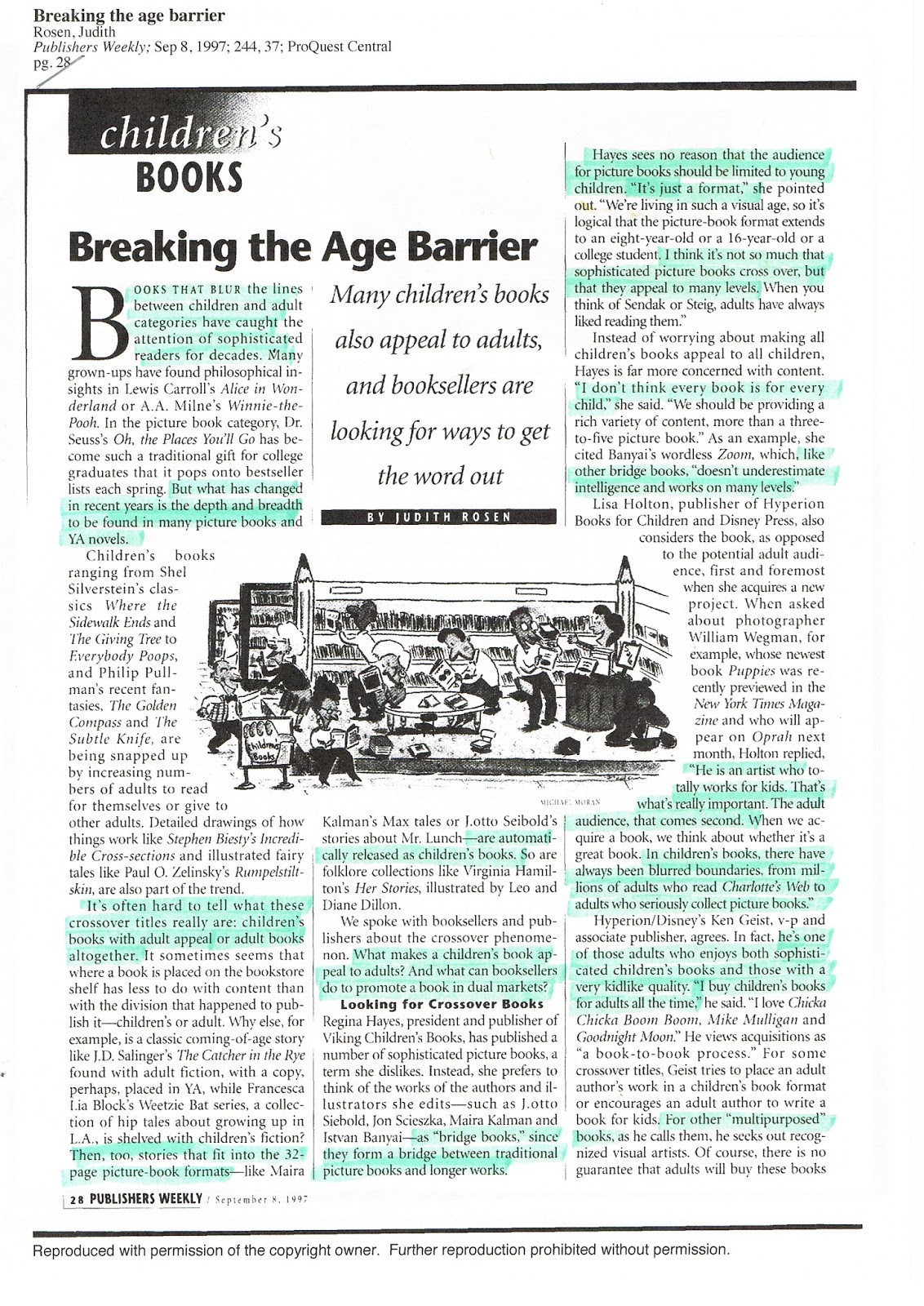
I have been reading a book titled crossover picture books by Sandra L Beckett in which she mentions a paper written by Judith Rosen. She describes this paper as a rare article in English speaking countries on the topic of the crossover genre in literature. I felt with such a description that perhaps this paper could be an important read as I possibly see my own work falling into the type of genre if it had to be boxed in or termed in some manner. The paper was written in 1997 and gives me an impression on the topics of that time. Surprisingly I actually don't see much change in the debate, certainly within the British publishing market. I realised whilst reading this paper that although it is very interesting and it is wise for me to become knowledgable in such matters it is not my primary concern. I want to write and illustrate things that interest me, things that I feel are important, and I want to work in such ways that they are more for me than any desired audience. This will allow me to find my voice and be able to create works that are destictively mine. Whether they fall into such genres or what audience they would be marketed at is something for the publishing world or even better the public to decide. This is the attitude I want to take with this project, yes I will be considering the fact that I wish for children and adults to enjoy my work equally, inviting them to discuss or debate the issues within my work. However the work must be initially for me, that way the reader will be getting the best I can give them. A short extract from the paper is shown below.


Journal study: Ain't gonna study war no more
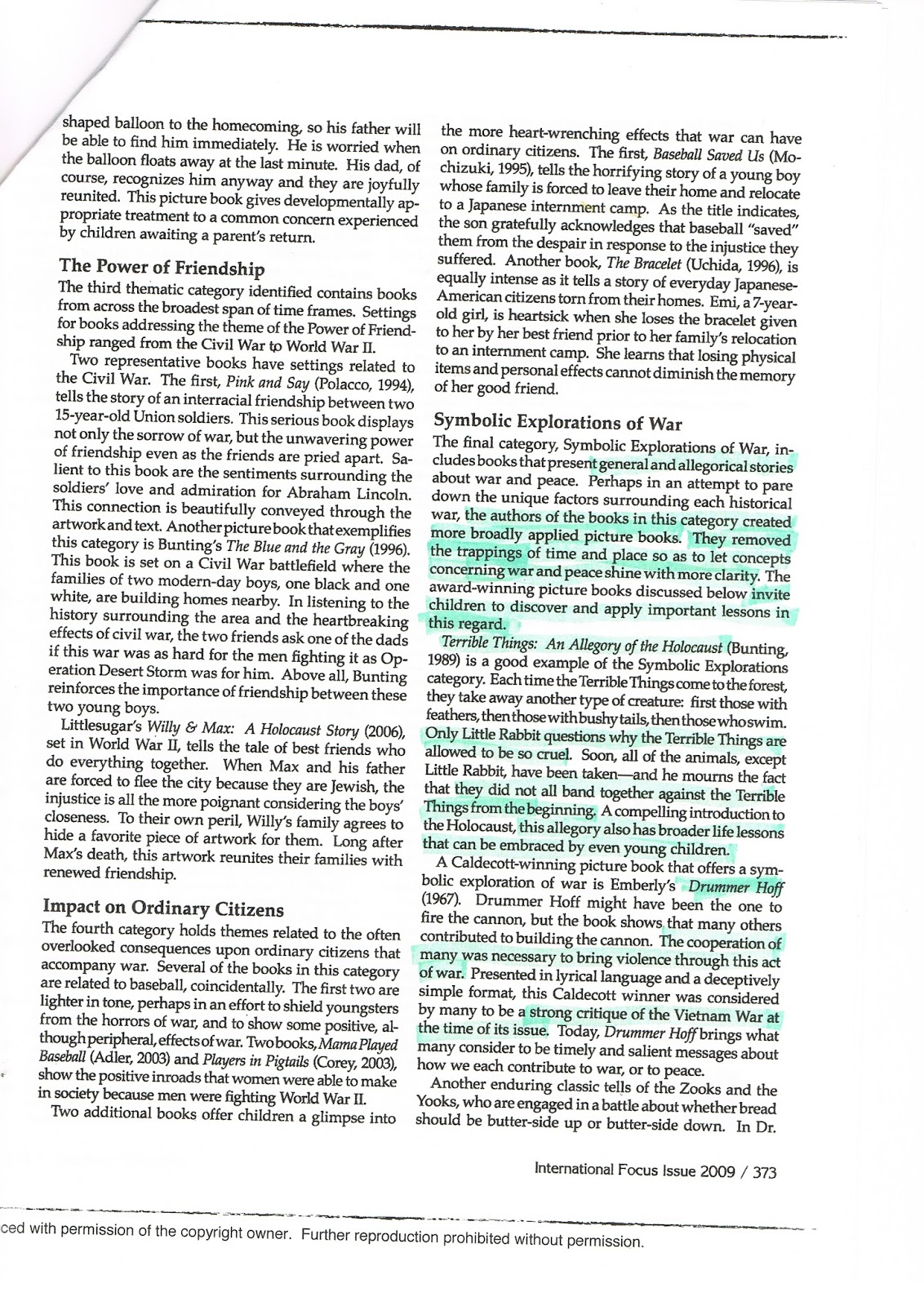
Authored by Patricia A Crawford and Sherron Killingsworth Roberts, this paper tackles the exploration of war through picture books. Although this paper concentrates on a different topic to that of my own project there are many similarities in the aspects that are considered within this work. Dealing with sensitive almost taboo subjects and how they might be addressed with children. My own work will not be aimed specifically at children but a more encompassing book that is essentially for all ages. Children will therefore have to be considered when I am exploring the subject of slavery. This comes as part of the territory of picture books as they are still largely regarded as a medium that is marketed for children, although this is something that is in debate. The paper studies differing methodologies explaining how a variety of picture books choose to portrait the issue of war. They looked for common themes within these books on which they concluded that there were five main themes. Coping with loss, separation from loved ones, the power of friendship, impact on ordinary citizens and symbolic explorations of war. From the five the symbolic explorations were of the most interest to me as they seem to offer more divergence in approaches and allow for broader interpretations without the need for harsh realities or time specific events. Extracts from this paper are shown below.


Wednesday, 11 November 2015
Stacey Dooley Investigates

Last night I watched a BBC documentary titled Stacey Dooley Investigates. The episode was series 7 episode 1 and focussed on the growing phenomenon of cybersex which is presently occurring in the Philippines. The concerning fact is that this is not between adults but involves minors and is fast becoming a billion dollar industry which relies on human trafficking along with physical and mental abuse which amount to another form of slavery. The fact I found most alarming was not the scale of the problem but that in many cases the perpetrators of the crime were parents abusing their own children in this manner. Many suspects or offenders claimed this was a means to escape poverty which is rife in this country. Sometimes they were held in cybersex dens, made to carry out all kinds of acts for webcams. In some cases the minors being held would see the police arriving as a bad thing because now they had no way of making money. What really struck me the most was when Stacey went to a refuge for some of these children. The physiological damage that had been done was very evident from seeing them going through some of their treatment therapies. I wondered especially for those abused by their own parents, how do they learn to trust again? This brought home to me how important it is to discuss such issues, raise awareness and that my project has definite relevance as this is happening right now even as I type this blog post. The sex trade has always been a major component of the slavery but the modern slave trade shows how new branches such as cybersex are now developing and preying on the poor and venerable.

Slavery footprint

Yesterday I found in interesting website http://slaveryfootprint.org which sets out questions about your daily life, the things you own etc. At the end they give an estimation as to many slaves contribute to your particular lifestyle. This to me was not about how accurate or false these estimations were but more about the considerations one should take on how your life choices can indirectly affected many others. Slavery like any other business relies on supply and demand of goods. The website made me think about the items I have in my house, who produced them? the food in my cupboards, who picked the crops? the clothes I am wearing, who made them?
What I realised is that whether I like it or not I probably contribute in some towards the slave trade. Whether I buy a brand of clothes who use children in sweatshops to make the items, whether the particular coffee I drink is harvested by forced labour I may never know. For me this just highlighted even more how deep rooted this problem has been throughout history and still remains, will it always be just a part of the human make up of society? How might I change my own actions or ways of thinking after reflecting on such points? Only time will tell what impact this information may have on me or others who have considered the relevance of their own actions upon the life of others.

Monday, 9 November 2015
wc 09/11/15 Progress, reflections and ideas
Progress
In the last week I have given my first presentation, found and read more papers and articles on a variety of subjects and created a mind map to highlight the areas of interest within my project.
Working with my programme this week shows both a continuation of reading journals etc and the beginning of my research proposal. I have printed out all information from blackboard, the honours year handbook and the slides from our lectures in regard to research proposal. I have also printed out some of the proposals from previous years which are on blackboard to help guide me with this process. This weekend I will also attend the first of the picture hooks talks held at the National Gallery in Edinburgh, the illustrators Cate James Tracey Smith will be in running this event.
Reflections
The last week has actually been a very reflective week, by choosing what to put in each slide I was able to see the current situation with my project. What kinds of things were influencing me, what working methods I use and how I think about and approach subject matter. The feedback received was very positive but it also brought up the issue of my question, which had been something I was having difficulty with. I may have been trying to keep to a narrow topic to define my research but I had been beginning to realise that my project involved more than just the use of visual metaphors. Instead thinking more of a visual statement and creating a mind map based around my story idea has let me see in a much clearer fashion. Using this map allowed me to highlight what topics each book, journal etc covered, this showed me visually where gaps are in my overall research. This also highlights that when any further research might be required on a particular topic which book covers such a topic. This does not mean that should be my sole resource but instead it should allow me to find other opinions and then see how they compare. This highlighted mind map is shown below.

Ideas
I need to write down several versions of a vision statement to see which feels closest to what I am trying to achieve. My mind map shows a large gap in research in the slave trade, however I am aware of research carried out within Abertay on modern day slavery. The abstract is shown on level 3 so I will need to check all detail and get a copy of the paper. This is very important as it deals with the issues regarding modern day slavery which is the issue I wish to raise through the book. Writing a first draft of my proposal is imperative, this will not only show me any other gaps in my work but may also clarify exactly what my questions, aims and objectives are for this project. The first draft should be written in first person just to allow me to get it out onto paper about what I am trying to say or hoping to acheive. The next draft can then be rethought and rewritten in third person. The paper I have mentioned is shown below although I must find full copy of the paper to analyize for myself.

Articles of interest: Expectations
Expectations: Titles, Stories, Pictures is the title of an article written by Perry Nodelman. The article explains how a series of experiments were carried out with students. Split into two main groups, one which had no taught knowledge of the workings of picture books and the second group would be tested once they had gained such knowledge. The tests were to see how this knowledge would affect the expectations of the students. The experiment would comprise of the students initially only receiving the title of the book, they would then write what they would expect it to be about. Then they would be given the first sentence from the book and asked how this compares to the title, what are their expectations now from the book? Next they would be read the whole story and once again asked questions on how they received the book compared to their expectations. Finally the students were shown the illustrations within the book. They were asked if they met with their expectations, how did they differ, had it changed their opinion on what the story was about? Both sets of groups showed a large difference in their expectations, the group who had learned more about the structure, plots etc used within picture books had more conventional ideas on what the book might be about. Some were far closer as to how the story may go, the group without prior knowledge seemed to be all over the place. This highlighted to me the importance of issues such as the title, opening sentence and how the illustration might oppose or reinforce the words. My own project will require more thought on how I want to approach such issues, do I want people to understand the story straight from the title. Perhaps I could use another title leading them to expect a story about something else. These types of issues will only be resolved by trial and error, perhaps testing on other will also influences my choices on such topics. Some extracts from the article are shown below.


Journal study: transnational and local identities
The paper is titled Children's literature in a global age: transnational and local identities. The topics covered are mainly related to how countries that had been a part of colonisation through history show both identities. Three main works from Canada, Australia and New Zealand were reviewed to show how some aspects remain from traditions taken from the British publishing world, and also to show how these works also tried to separate themselves from such traditions. The paper highlights many aspects of what is happening both globally and more locally within regions with regards to works that are being published or sponsored by governments. This was interesting as it gave me a small insight into what is happening elsewhere and also shows the importance of my own work. I did only read half the paper as the second half divulges into the book The Arrival by Shaun Tan. This particular book is one of my considerations for my case studies. Therefore I wish to do my own analysis before being influenced by the opinions of others. This paper is something I will refer back to and use as part of my case study when the time comes. Extracts of the paper are shown below.


Subscribe to:
Posts (Atom)