I have read an academic essay written by Megan McSherry titled Between Science and Art: Representing Cancer in Paediatric Oncology. The paper centres around her project which researched the use of images between physicians and patients to explain the various forms of cancer, treatments and procedures. The aim was to create a picture book that could be used as a tool to aid physicians in explaining cancer in a way more beneficial to those who learn visually. The book could also be used by parents to help in enabling them to discuss the issues of their child's disease in an unobtrusive manner. The paper highlights several considerations that must be taken into account when dealing with such difficult topics. How children understand and what adults belief they are capable of understanding is discussed, how the images can really reflect upon the subject matter are just a few. Issues such as the physicians being portrait in more casual clothes than the usual white lab coat to break down the barriers between patient and physicians, also no desks or furniture between both to build upon that togetherness. The book uses several characters to allow for variants of types and issues relating to cancer to be explored. This also allowed for a broader scope of diversity within character types, ethnicity etc which creates more inclusiveness to a larger group of readers. The book does not offer a fairy tale happy ending as many children's books do, instead it shows hope with remission but no one is 'cured', other characters may appear then just as quickly disappear opening up questions as to what might have happened to them. This paper was a very interesting read and has opened my eyes on how others are trying to use the picture book format to tackle difficult subjects. Using this type of research will help to broaden my own particular views and will hopefully allow me to think more divergently as I progress through this project and further into the future if I retain the same approach in other works. Some exerts from this essay are shown below.
Monday, 9 November 2015
Saturday, 7 November 2015
Mind map and story idea
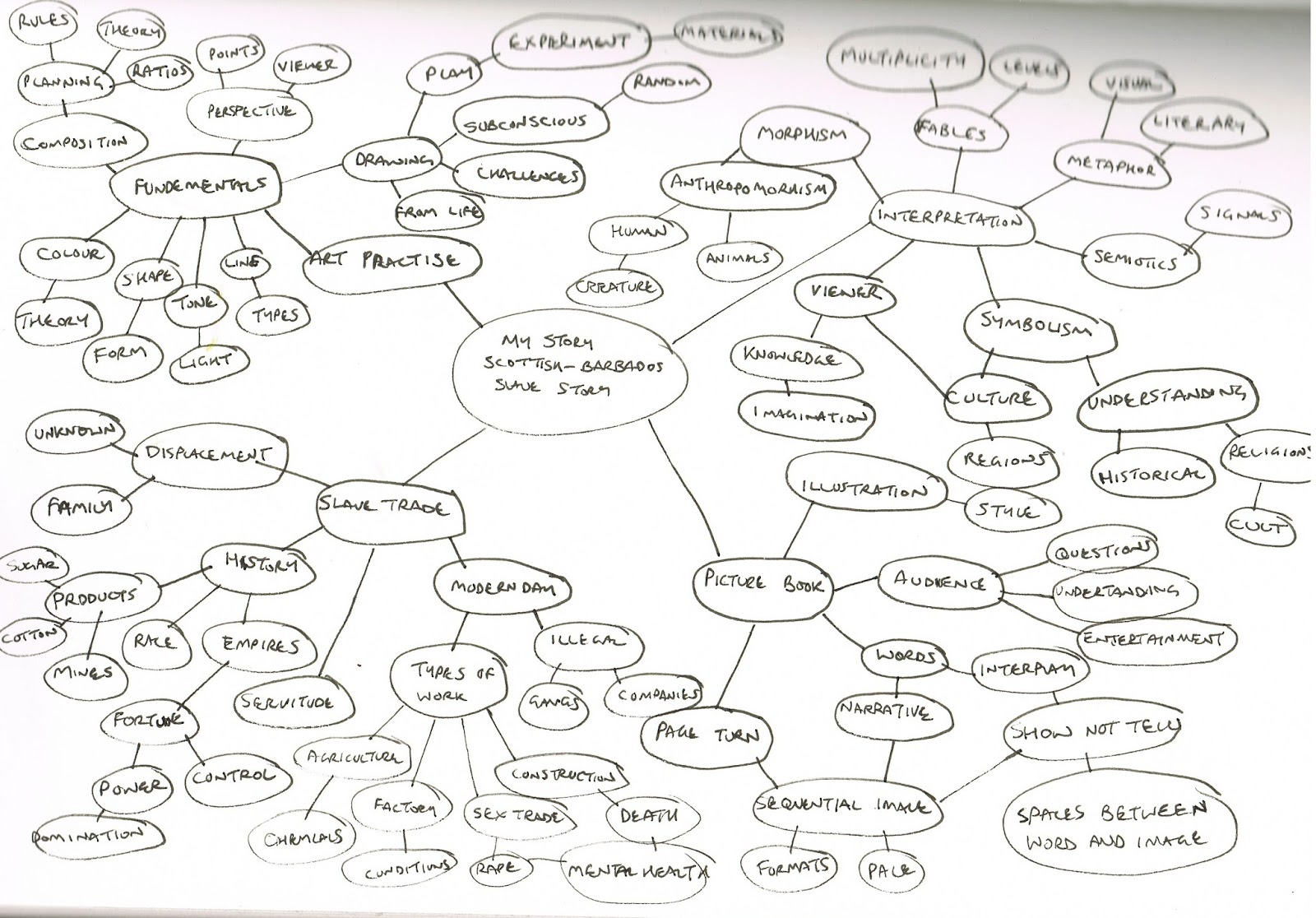
After my discussion with Brian earlier in the week I decided to make a mind map of the various issues or topics that may be explored through my project. This is slightly different to the jellyfish method described earlier in my blog. The jellyfish involved more questions and possible questions that could lead from these. The mind map has put my project at the centre, which I realise could not have been done at the time of the jellyfish as I had no idea what my project was about at that point in time. However since then I have developed an idea to create a picture book which is based upon an old Scottish tale/myth. I classify it as both tale and myth as there are still ongoing arguments between historians around the actual facts of the matter.
The story is based around the Scots involved in the battle of Dunbar in 1650 who were taken as prisoners, then were eventually sent to Barbados to work in the sugar cane fields. Whether they worked a servitude of several years or were classed as slaves is up for debate. However to me in both cases and from their perspective they were working as forced labour which is slavery. I do not plan to tell this tale in a historical context or for it to be educational, I wish to use this story as my main thread or tool that allows me to bring up the issue of modern slavery.
The trail of thought that has lead to the choice of this story most likely begun when I was thinking about the whole issue of Empire. I realised that almost all Empires were built upon the back of Slavery, Egyptian, Roman or our own British Empire relied on such inhumanities as a contributor to their success. Thoughts about the refugees that are fleeing to Europe right now had also been playing on my mind. I thought not only about what these people must be running from but also about what might happen to them. I hope for many that the path may become brighter however I also fear that many will succumb to the slave trade. This may not be a choice but more of a necessity in the need to survive. Food and aid will not always be given or received, jobs most likely will not be available to everyone. The sharks will see easy prey who can be enticed with a few promises or lies, they will then be pulled into the world of slavery without even knowing.
This is why I feel a book that brings up the issue of modern slavery is important. It is not only relevant to the refugees I have discussed but to the millions of people worldwide who are already consumed by such a trade. The reason this particular story is to be used as a thread or tool to bring up the issue of modern slavery is that it gives me a way into such a topic. It is something I only found out about recently but it is also more relatable to me. Dunbar is not far from where I was brought up so it makes it easier for me to use than a story based on Africans stolen from a land I don't know. This only gives me an inroad, the issues of race, who were slaves, who done servitude of several years are not the important factors for me. I cannot change history but I can influence the future with my own little contribution. There are people today, right now at this point in time having to work as slaves. They are all over the world, they may have to work in the sex trade, they may have made the clothes you and I are wearing, they may be out begging on your street. The slave trade does not discriminate against race, colour, gender, age or sexuality. This book should should also be the same, my aim is to highlight the plight of many who suffer oppression around the world and bring into question who are the slaves. Within a historical context todays society keeps the slave trade comparatively hidden but it still remains, is this something that will always be? The aim of the book is to open up discussion, hopefully if done as I imagine it to be then each person may have their own interpretation or be able project their own memories or stories onto my book.
The mind map process has shown me that there are four main areas of consideration for my project. The slave trade itself, the picture book format, how it might be interpreted and my own arts practise are the four main branches of this map. Each of these may require there own maps once I begin to delve deeper into the topics. However for now this has helped me define in my own mind where my project currently sits and the topics that might be researched as part of this project. I can see a new plan of attack which will involve plunging into a topic once a problem has arose with my work on the book, retrieving the information I require and getting back to work on the book. This process will continue as each problem arises, some solutions may not be found in the exact order I wish but that is just part of the research process as a whole. The mind map is shown below which will hopefully lead to my vision statement or overall question I am trying to answer.
Thursday, 5 November 2015
Ways of Thinking and Making
Introducing Semiotics
Whilst I was visiting the Tate Modern a few weeks ago I picked up this book on semiotics. The book explains in a very visual way the history and thinking behind semiotics. The works of people such as Saussure, Pierce and Levi-Strauss to name a few. I bought this as so many of the papers I have read touch upon the subject of semiotics without me really knowing what the subject is about. There are severals points within the subject that I have found hard to get my mind around at first reading. However I have marked several areas I feel are important and will read them again once I have given the book some time to float around in that skull of mine. This topic may become an influential factor upon my work so being able to gain a better understanding of it is important. For now I will leave aside a refer to once I begin my proposal. This will most likely appear within the mind map I am planning to create to see what other factors I may have missed so far in my project. some examples of the types of ideas raised and discussed within this book are shown below.
Presentation feedback
Yesterday I gave my presentation on where my project was going prior to our research proposal. The feedback I received was very positive, in general I was told to keep up with the variety of influences I have been looking at i.e. fine arts, theatre etc. I was also advised that in my general art practise of sketching the world around me I should try to draw dancers. This is something I had already given thought to so I will follow this up and use either Dundee Rep or Dancebase for this type of exercise. The idea I proposed was considered a very deep, dark subject that would give and interesting topic on which to base my work. The thinking behind my project was perceived as high level thinking although the question I was offering as my research question was scrutinised.
This was something I was actually pleased about as I often feel as though this is the part I have been struggling with most. Brian had raised the issue so I felt that it was important to go and speak to him about my question this morning. As he explained many things I began to realise that I have possibly been approaching this more in a scientific manner than artistic. I have felt that first I must understand theory and have found all my information before trying to create any practical works. I had not considered that by creating art I was effectively creating data. This may now lead to a slightly different approach. I will now try taking my story as the centre point and see what elements i.e. narrative, fables, metaphor, symbolism etc all thread off of my main story. I need to collate the information I have already found, then create a mind map showing what I believe will be involved or may contribute to my story. This might highlight areas I have not investigated, then begin to really work on my story and as issues or problems arise I can then research how others have dealt with these issues. this will then form a more practise based research which I had been planning to do after my research proposal has been handed in. I was also advised not to dwell to much on the question and rather to think more of a vision statement as this may help clarify in my mind what is involved in my project and will also help determine my question.
Monday, 2 November 2015
wc 02/11/15 progress, reflection and ideas
Progress
This week has been about journals, a presentation and a workshop. The number of journals blogged has not been as high as I wished. However this will continue this week, I have also read some books which have not made it into the blog just yet. All readings must be mentioned this week.
My programme shows a continuation of readings for this week, blogging about this will let me begin to collate the information I have been looking at which I have found interesting. This is imperative as this information will form the basis of my research proposal, it may also show gaps in my research and might determine the nature of my main question. On wednesday I will give the presentation about my project which will hopefully lead to some useful feedback.
Reflection
Although I have not mentioned as many papers as I thought I would have, this week has still been successful. This is in large due to compiling my thoughts for a presentation. This process has actually worked as a great tool to allow me to reflect on what has influenced me and where I currently stand with my project. The presentation has also shown me how I work best, by effectively feeding myself with either information or inspiration. This method of working will hopefully allow me to absorb as much as possible and then hope that many of these influences start to come back out through the work I produce. Taking part in workshops such as the Taku-hon pad printing highlighted to me how by doing different things I usually get unexpected results or ideas arising from these types of things. This was evident in that I went to see about textures and left with ideas on representation. Another example is the play Dragon I went to see a few weeks ago, it only occurred to me a few days ago that I actually witnessed a magical display of visual metaphor through the dragon itself. This had been so well done that it has taken me weeks to come to that realisation. By feeding myself information and inspiration I hope that this becomes a reoccurring theme. By taking things in and then letting my subconscious play around with them for some time and then possibly resurfacing somehow. It will be interesting seeing how this might then affect whatever I am working on at that point in time.
Ideas
To carry on with reading as much as possible as this time next week I must begin to collate all of the information I have highlighted. Give my presentation and see what feedback is received.
Sunday, 1 November 2015
Taku-Hon
Over the last two days I have attended a workshop on Taku-hon printing. This is an ancient Chinese technique although the name derives from Japan. I went to try to see if I could create textures similar to those found in a book titled The Ship that Sailed to Mars by William M Timlin (Fig 1).
To my surprise the technique allows for far more experimental and varied use than I had imagined. One really useful technique involved taking three dimensional objects and then printing from them. We wrapped the wet paper around whatever we decided, my example is that of a small drill (Fig 2). Once the paper had been worked into the grooves or details of the item we would then let it dry out until we felt ready to print. The item could then be inked using pads and the finished print might give the object a brand new life. The print might not seem recognisable to the item itself but this was what seemed the most interesting to me. My example of a drill is shown below with a few other examples and the description sheet which gives more details about the technique itself. Prior to the weekend I had thought that my presentation would be unlikely to include this workshop, but this has not only shown me a new method of working it has shown me a new way to represent things in a totally different way and so will now be included.
![]() |
| Fig 1 |
![]() |
| Fig 2 |
Subscribe to:
Posts (Atom)